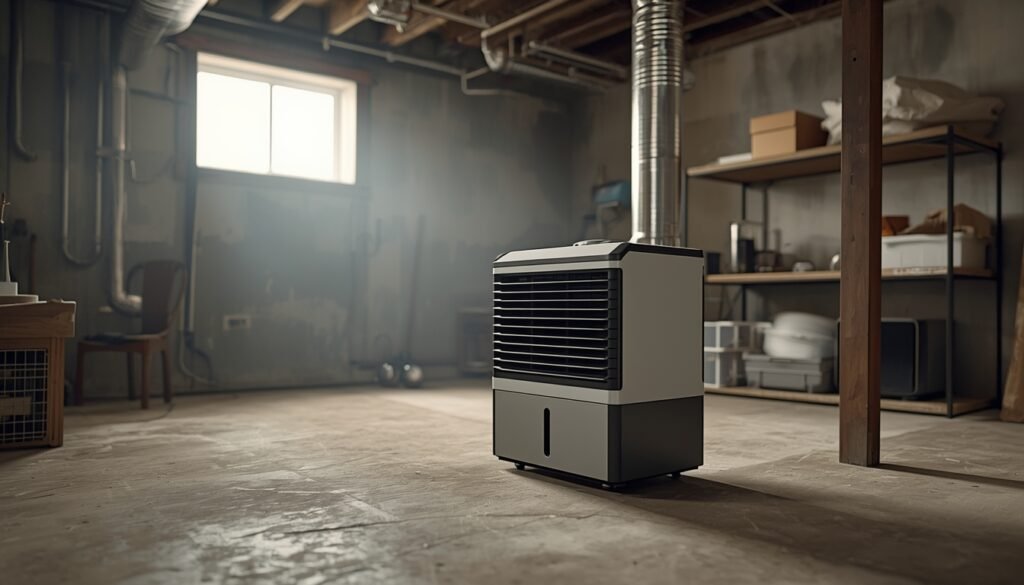
Choosing the correct dehumidifier size is one of the most important steps when trying to control humidity in a basement. A unit that is too small may run constantly without lowering humidity enough, while a larger unit can remove moisture more efficiently and stabilize conditions more quickly.
Understanding how dehumidifier capacity works helps homeowners choose equipment that matches both the size of the basement and the amount of moisture present in the space.
Understanding Dehumidifier Capacity Ratings
Residential dehumidifiers are typically rated by how much moisture they can remove from the air within a 24-hour period. This measurement is expressed in pints of water per day.
A higher pint rating means the unit can remove more moisture. Basements that are larger or more humid usually require a unit with a higher capacity rating.
Manufacturers also provide recommended coverage ranges, which estimate the square footage each unit can handle under typical conditions.
Why Basement Size Matters
The overall size of the basement plays an important role when selecting a dehumidifier. Larger spaces contain more air volume, which means more moisture must be removed in order to reduce humidity levels.
However, square footage alone does not determine the best size. Two basements with similar dimensions can have very different humidity conditions depending on drainage, airflow, and moisture sources.
Finished basements, for example, may hold humidity differently than unfinished utility spaces with exposed concrete walls.
How Moisture Levels Affect Sizing
Humidity severity is often just as important as basement size when choosing a dehumidifier. A basement that only feels slightly damp during humid months may require a moderate-capacity unit, while spaces with visible condensation or musty odors may require a larger machine.
Signs that the basement may have higher moisture levels include:
- persistent musty smells
- condensation on pipes or windows
- damp cardboard boxes or fabrics
- visible mold spots
- high humidity readings on a hygrometer
In these situations, selecting a larger capacity unit often improves humidity control.
Typical Capacity Ranges for Basements
While exact recommendations vary, many homeowners start with general capacity ranges.
Smaller basements with mild humidity can often be managed with moderate-capacity units. Larger basements or areas with persistent moisture may benefit from higher-capacity machines designed to remove greater amounts of water from the air.
The goal is to choose equipment that can maintain humidity levels without running continuously.
When Choosing a Larger Unit Makes Sense
In some situations it is safer to choose a slightly larger unit than the minimum recommended size. This can help the machine stabilize humidity levels more quickly, especially during very humid weather.
Choosing a larger unit may be beneficial when:
- the basement experiences seasonal humidity spikes
- the space contains laundry equipment
- there are minor moisture issues around the foundation
- air circulation is limited
- the basement is used for storage
A larger unit can often remove moisture more efficiently and maintain stable humidity levels throughout the space.
Other Factors That Affect Dehumidifier Performance
Even a properly sized unit can struggle if it is installed in a location with poor airflow or inadequate drainage. Placement and continuous drainage options can significantly improve how effectively a dehumidifier controls basement humidity.
Understanding how these factors work together can help homeowners choose equipment that performs reliably over time.
For a broader explanation of basement moisture control and equipment selection, see our basement dehumidifier guide.