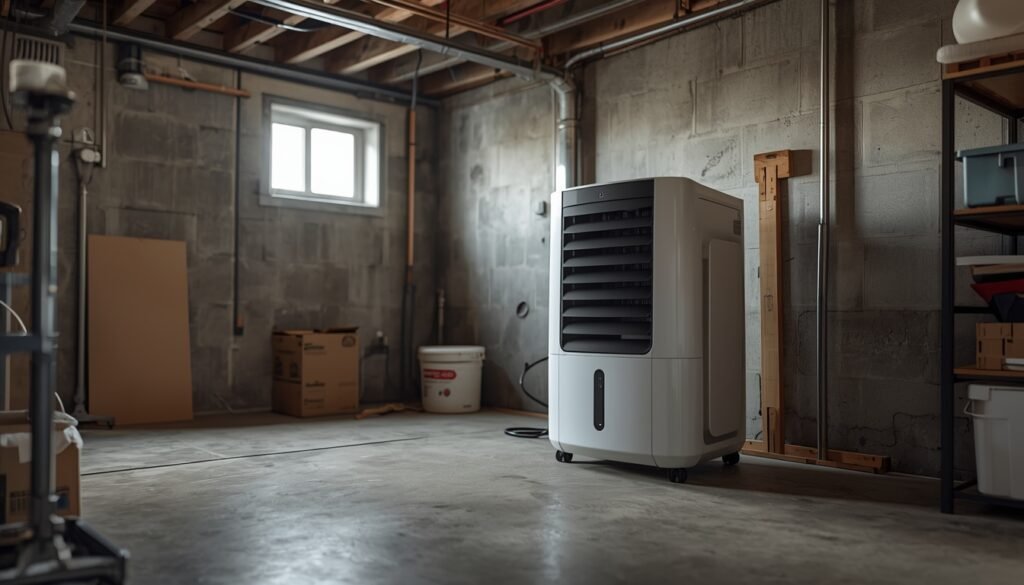
Where a basement dehumidifier is placed can have a significant impact on how effectively it controls humidity. Even a powerful unit may struggle to reduce moisture if it is located in a corner with poor airflow or positioned far away from the dampest part of the basement.
Proper placement helps the dehumidifier circulate air efficiently and remove moisture from the entire space rather than only the immediate area around the machine.
Why Placement Affects Dehumidifier Performance
A dehumidifier works by pulling humid air across cooling coils where moisture condenses and is collected for removal. For this process to work efficiently, air must circulate freely through the space.
If the unit is placed in a tight corner or surrounded by objects, airflow can become restricted. This prevents the machine from drawing humid air from across the basement and limits its ability to control moisture levels.
Placing the unit where air can move easily allows it to remove moisture more consistently throughout the room.
Central Basement Placement
In many homes, placing the dehumidifier near the center of the basement provides the best airflow coverage. This allows the machine to pull humid air from multiple directions and distribute dry air evenly.
Central placement can be especially helpful in unfinished basements where the space is open and air can circulate freely.
However, not all basements allow central placement due to drainage or electrical outlet locations.
Positioning Near Moisture Sources
In some situations, it may be more effective to place the dehumidifier closer to areas where humidity tends to accumulate. These locations may include:
- near foundation walls that feel damp
- close to laundry equipment
- near sump pits or floor drains
- areas where condensation frequently appears
- spaces where musty odors are strongest
Placing the machine near these moisture sources can help reduce humidity before it spreads throughout the basement.
Allowing Adequate Airflow Around the Unit
Most dehumidifiers require several inches of clearance around their air intake and exhaust vents. Blocking these vents can reduce airflow and decrease the machine’s effectiveness.
It is usually best to keep the unit away from walls, furniture, or storage boxes that could interfere with air circulation.
Providing sufficient clearance allows the machine to operate more efficiently and maintain consistent humidity levels.
Considering Drainage Options
Many basement dehumidifiers allow continuous drainage through a hose connection. This setup can eliminate the need to manually empty the water collection bucket.
When choosing a placement location, homeowners often consider proximity to a floor drain, sump pit, or condensate pump.
These drainage options allow the machine to run continuously during humid periods without requiring frequent attention.
Monitoring Humidity After Installation
After installing a dehumidifier, it can be helpful to monitor humidity levels for several days to confirm the placement is working effectively.
A small hygrometer placed in the basement can provide a quick reading of humidity levels. Ideally, basement humidity should remain between roughly 40% and 55%.
If humidity levels remain high, repositioning the unit or improving airflow may improve performance.
For a broader explanation of how dehumidifiers help control basement humidity, see our basement dehumidifier guide.